
What is OI for you?
Written by Ingunn Westerheim, OIFE president
 Stephanie Claeys and I had the great pleasure of traveling to Dundee, Scotland, to attend the conference organized by the Brittle Bone Society. You can see the entire programme here.
It started with a scientific symposium – with talks about new developments in research and clinical care. Topics covered were new and potential therapeutic approaches, pain, non-union fractures, muscles and tendons, neurological issues in OI and much more. Participants were mostly OI professionals – but also some patient representatives from the BBS and from OIFE.
July 25 brought another conference day focused on research, but now with a more mixed audience – where the majority were people with OI themselves. We got to hear about why the voice of people with OI is important in research and advocacy, and how each and every one of us can contribute on different levels. We got to hear testimonies from adults with OI – and how their experiences had been shaped depending on whether their OI was visible or not.
 Personally, I was together with Tracy Hart (OIF), invited to give a talk about the IMPACT survey and what we have learned so far. Our talk was placed in the session called Market Access. And one of the ways we can use the patient experience data (PED) from the IMPACT survey, is to inform the health technology assessment (HTA) bodies in different countries about the unmet needs of OI. We can also use the data in discussions with payers such as national welfare authorities and public and private insurance. Hopefully this will help us access to the many potential therapies for OI that are being investigated at the moment.
Before the access session – we were asked to contribute to a Menti question called “What do you call your OI?”. This might seem like a very basic question, but if we dig deeper into it – it’s quite complicated. Answers might vary from “brittle bones”, to OI type 16 and OI tarda. Some might call their OI a nasty disease, and some might even consider it a blessing – due to the strong community they are part of.
OI – is of course an abbreviation of the Latin term osteogenesis imperfecta. Very commonly known as brittle bone disease. But as we have documented through the IMPACT survey – fractures are far from the only issue people with OI are struggling with. For children with OI, pain is reported to be the number one issue, and fractures are number two.
But for adults with OI, pain, fatigue and soft tissue are the most frequent causes of health problems in adults with OI. And fractures are all the way down to nr. 13. But that doesn’t mean that fractures are not important. When they happen – they have a huge impact on an adult’s quality of life.
Fractures cause pain, loss of mobility, non-unions, time away from work and in some cases, people might lose their jobs or mobility permanently. Brutal, right? Months might be spent in hospital or rehabilitation centres, to recover independence. And in some cases – adults with OI are sent to homes for the elderly, just because they cannot function at home without assistance for a while. Assistance is not that easy to find unless you plan things well in advance. And fractures aren’t normally planned. They happen when you least expect it. And it’s never a right time.
So yes – OI is still about brittle bones. But the name is misleading, because OI is about so much more than fractures and bone density. It’s a genetic collagen condition and all body parts affected by collagen can cause health issues for a person with OI.
And then there is the tricky classification. In early days – OI used to have two different labels – Congenita (from birth) or Tarda (late onset). Then professor Sillence came up with his clinical classification system of four different clinical types – based on clinical picture and severity. OI type 5 was later added, with its distinct clinical criteria including excessive callus formations and wrists with rotation problems.
And then came the genetic discoveries which gave us many new (genetic) types. I turned out that OI was caused not only by the collagen genes Col1a1 and Col1a2. OI could also be caused by a number of other genes affecting collagen production in different ways. This gave us a list of genetic OI types which now exceeds more than 20 different genes. And a new classification system.
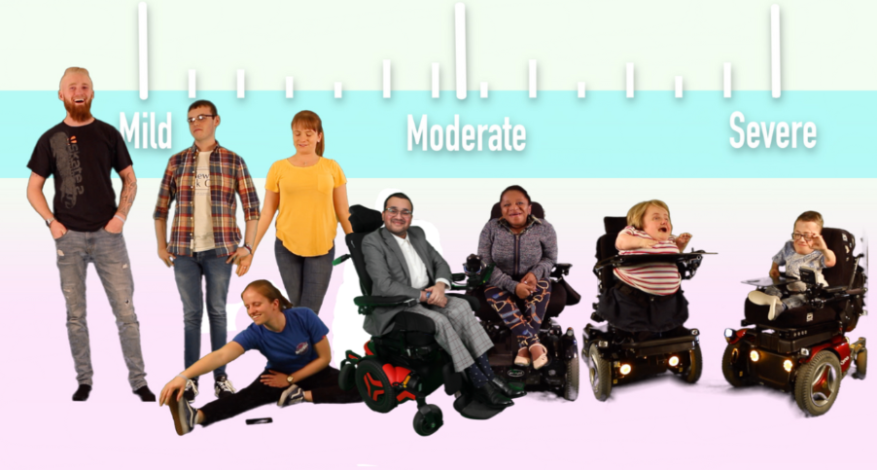
And the major challenge is – the gene involved doesn’t say that much about your clinical picture. People with completely different genes can look the same and have similar health problems due to their OI. These constant discoveries of new and recessive genes made people confused. And maybe this is why some clinicians started to use the terms mild, moderate and severe OI. Brilliant – right? Severe OI is OI type III – small stature, wheelchair user, scoliosis etc. Mild OI is typically OI type I – normal height, blue sclera, and quite (or completely) invisible OI.
 https://ojrd.biomedcentral.com/articles/10.1186/s13023-024-03126-9
But even if your OI is invisible – it doesn’t mean that you don’t have issues! It just means that your surroundings don’t see your pain, fatigue and hypermobility. They don’t understand it – because it’s invisible. With visible OI, it’s often the opposite. People with visible OI strive to be normal or project a normal life. People look at us and see a disabled person, with all the ableism this comes along with.
We get an education and a job and we navigate a world that is sometimes completely inaccessible for us. Which makes us totally exhausted. As one of the participants of our Oslo meeting said: “They see me here with a degree attending this important conference – but they don’t see the energy it took me to get out of bed, shower, get dressed and just showing up”.
So even if it’s tempting to use the labels mild, moderate, severe – the real picture is fuzzy and complicated. What if a person with invisible OI has become deaf because of his OI? His OI doesn’t feel mild, because the impact OI has on his life is severe.
And if you are a fit young OIer who haven’t fractured in years – you might call your OI moderate or even mild. Because you don’t feel that the impact of your OI is that severe. Especially if you compare yourself to some of your peers, who have problems with moving, breathing, and needing assistance 24/7.
So, what is OI? Well, I am sorry to say – it depends on who you ask or who’s head you are in. Is it a basic researcher answering, a clinical geneticist, a paediatrician, a physio, a parent, a young athlete, or an older adult with invisible OI who has gone deaf? And it might also depend if you are in a good state of life or a bad one.
My point is – we need to find a way to label OI which everyone can live with – ideally less confusing and more intuitive. And we need to accept that not all people with OI feel “at home” in the labels mild, moderate, severe.
Perhaps the answer is using different classification systems for different purposes? However – it needs to be clear to all of us when we are talking about what? Are we talking about genetics, precision medicine or about which clinical signs a GP should be aware of? Or about how we look? Or are we asking people with OI to define their OI severity in surveys and registries?
We need to be sure when we are talking about apples and when we are talking about pears. Because if we don’t – we might have very confusing conversations and conclusions. A fruit salad basically!
This is one of the questions I would like to discuss with our new advisory board – which consists of both basic researchers, clinicians and of patient experts who have OI themselves or children with OI. Together we can perhaps get closer to an answer or several answers to the big and complex question of “What is OI to you?”.
Hopefully we will have some proposals to discuss at our topical meeting in Copenhagen in 2026.
We hope to see you there!
This article has first been published in OIFE Magazine 2025-03.


